
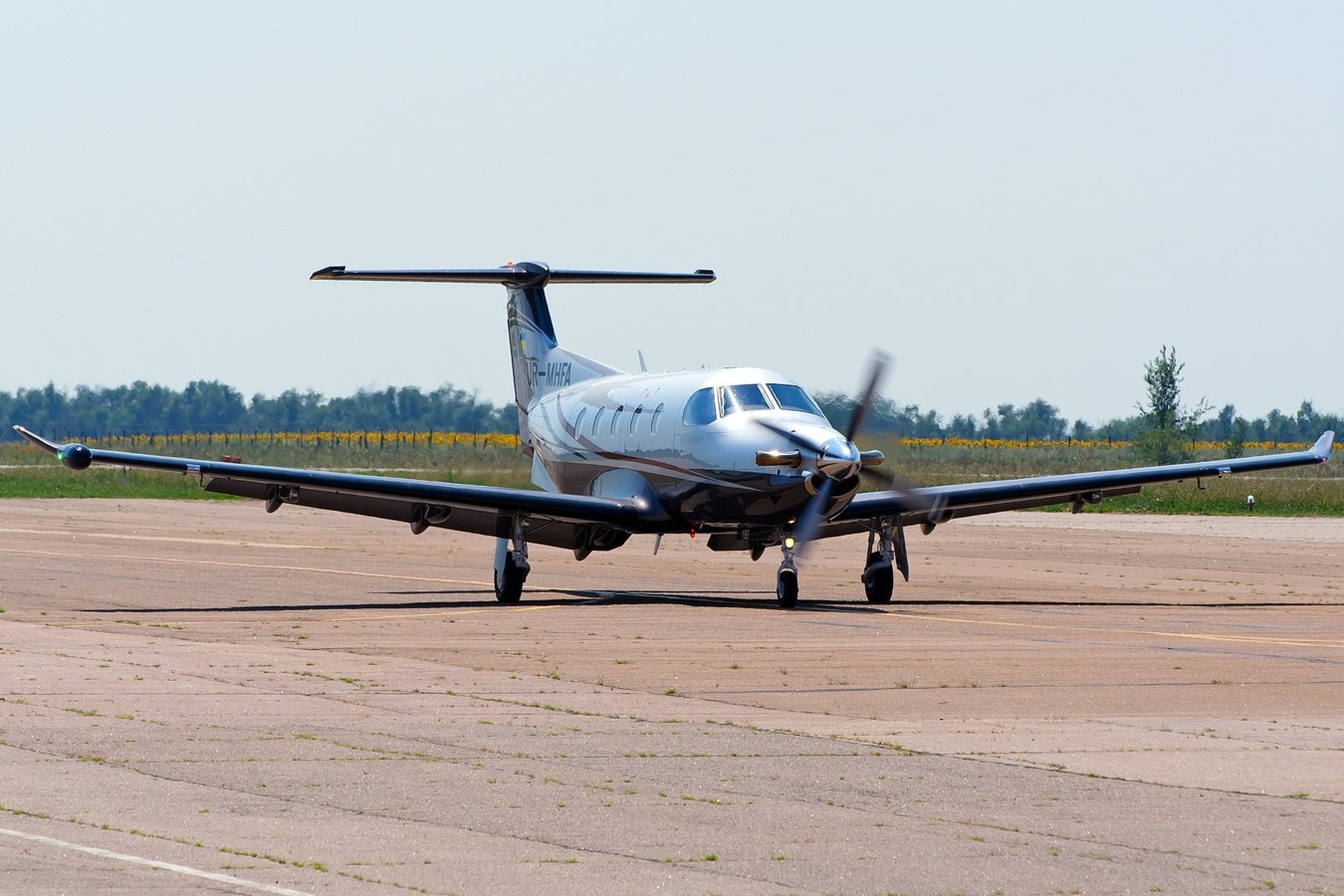
When a Bahamas trip calls for a turboprop instead of a jet, the decision almost always comes down to two aircraft: the Pilatus PC-12 and the Beechcraft King Air 350. Both do the job. Both are produced by well regarded manufacturers, flown by top Part 135 operators on the Florida to Bahamas corridor, and certified for the kind of short field grass strips that serve the Out Islands. The differences between them, however, are real, and the right choice depends on your group size, your budget, your comfort with a single engine profile, and the specific airports in your itinerary.
This comparison is written for clients who have already ruled out a jet, either because the runway will not take one (Staniel Cay, most private strips in the Exumas) or because the trip economics simply work better on a turboprop. We will walk through the spec sheet, the passenger experience, the safety conversation, real client scenarios, and where each aircraft wins.
In this comparison
Quick Comparison Table
| Spec | Pilatus PC-12 NGX | King Air 350 |
|---|---|---|
| Passengers (typical exec config) | 6 to 8 | 8 to 9 |
| Engines | 1 x P&W PT6A-67P | 2 x P&W PT6A-60A |
| Max cruise speed | 290 KTAS | 312 KTAS |
| Typical cruise | 280 KTAS | 300 to 310 KTAS |
| Range (max fuel, reserves) | 1,803 nm | 1,806 nm |
| Service ceiling | 30,000 ft | 35,000 ft |
| Cabin (stand up height) | Yes (4 ft 10 in) | No (4 ft 9 in, rolling) |
| Pressurization differential | 5.8 psi | 6.6 psi |
| Balanced field (sea level, std) | ~2,485 ft | ~3,300 ft |
| Wet hourly charter rate | $2,000 to $2,800 | $2,800 to $3,800 |
| Baggage volume | 40 cu ft (heated, internal) | 55 cu ft (internal + nose) |
A few observations before we go deeper. The King Air 350 and the PC-12 are within three nautical miles of each other on max range, which means either aircraft can comfortably handle any Bahamas or Turks and Caicos leg without a fuel stop. Typical cruise altitudes of 25,000 to 30,000 feet on the PC-12 and 27,000 to 33,000 feet on the King Air put both aircraft well above the scattered cumulus that builds over the Bahama Bank in the afternoon, so ride quality through the middle of the day is usually smooth on either airframe. Block times are close enough that on the typical 45 minute to 1 hour 30 minute legs that define this market, the speed difference translates to a handful of minutes rather than a meaningful schedule change. Where the two aircraft genuinely diverge is on the cabin, the cost structure, the short field envelope, and the operator philosophy around overwater single engine operations. Those are the dimensions that should drive your decision, and they are the dimensions we work through with every client.
Engines and the Overwater Conversation
This is the single biggest philosophical difference between the two aircraft, and the one clients ask about most. The PC-12 is powered by a single Pratt & Whitney Canada PT6A-67P. The King Air 350 carries two PT6A-60A engines. Across most of general aviation, "two engines" is read as "safer," and for many clients that shorthand is enough to settle the decision before they even sit down with us.
The reality is more nuanced. The PC-12 is the most delivered single engine turboprop in its class, with more than 1,900 airframes flying worldwide and a cumulative fleet record that ranks among the safest in general aviation. The PT6A family as a whole has one of the lowest in flight shutdown rates of any turbine engine ever produced, on the order of one event per 333,000 flight hours according to manufacturer and operator data. Part 135 operators flying the Bahamas corridor on a PC-12 generally fly a power off glide profile, which keeps the aircraft within reach of either land or a suitable ditching location throughout the route. The aircraft is certified for single engine IFR and carries a liferaft, life vests, and an ELT on any Part 135 overwater trip.
The King Air 350, with two engines, offers redundancy at the propulsion level. If one engine fails in cruise, the aircraft can continue on the remaining engine and reach any nearby airport. For some clients this is decisive, particularly on longer overwater segments (think Turks and Caicos or deeper into the Out Islands beyond line of sight to land). For other clients, the statistical rarity of a PC-12 engine failure, combined with the PC-12's single lever power and modern Honeywell Primus Apex avionics, makes the single engine an acceptable tradeoff for the cost and cabin advantages.
Our rule of thumb: if you will sleep easier knowing there are two engines on the wing, book the King Air 350. If you are comfortable with the data and want the better cabin and lower rate, the PC-12 is the right call. Both aircraft, flown by vetted operators, meet the risk profile we are willing to put our clients on.
Cabin, Comfort, and Baggage
The PC-12 cabin is the single biggest reason it has become the default choice for HNW family travel to the Out Islands. It is a stand up cabin, 4 feet 10 inches in height, 5 feet wide at the widest point, and nearly 17 feet long. The executive configuration seats six to eight in a club four plus divan or forward facing layout, with large oval windows, a forward galley, and an aft lavatory separate enough to be called private. The 40 cubic foot baggage compartment is internal, heated, and accessed through a dedicated cargo door that makes loading ski bags, dive gear, or strollers a non event.
The King Air 350 has a cabin that is technically similar in dimensions, 4 feet 9 inches tall and 4 feet 6 inches wide, but the proportions and the layout feel different. The cabin is longer overall (19 feet 6 inches from cockpit bulkhead to aft bulkhead), which accommodates nine passengers in a double club configuration and a small aft galley. The baggage compartment is split between an internal locker and a nose bay, for a total of roughly 55 cubic feet, more than the PC-12 and genuinely useful for larger groups. Pressurization differential is slightly higher (6.6 psi versus 5.8 psi), which means the King Air holds a sea level cabin a bit higher into cruise, though for the short legs flown in the Bahamas corridor this is not a practical difference.
Both cabins offer electric window shades, in seat USB power, and operator supplied catering. Wi Fi is spotty on older King Air 350s and hit or miss on older PC-12s; newer NGX and later King Air 360 airframes are much better. If connectivity matters, ask the broker which specific tail number is being quoted and what its Wi Fi spec is.
Short Field Capability
This is where the PC-12's single engine is actually an advantage. Because the aircraft is lighter and its wing is optimized for short field performance, a PC-12 can operate safely off runways as short as 2,500 feet at sea level in standard conditions. The King Air 350, with its higher max takeoff weight and the complexity of two engine performance planning, needs roughly 3,300 feet at a balanced field length. On a 3,000 foot strip like Staniel Cay's MYES, that matters.
PC-12 operators regularly fly Staniel Cay (MYES, 3,000 ft), Cat Island (MYCB, 4,500 ft paved), Spanish Wells (MYEL, 3,400 ft), and most of the private island strips scattered through the Out Islands. King Air 350 operators fly Staniel Cay too, but they do it with a conservative crew and a lighter fuel load. On anything under 3,000 feet, the King Air 350 is a no go, while the PC-12 continues to have options.
For destinations like Marsh Harbour (MYAM, 7,000 ft), Governor's Harbour (MYEM, 7,000 ft), Exuma International (MYEF, 7,000 ft), and Providenciales (MBPV, 9,000 ft), runway length is a non factor and the choice between aircraft comes down to passenger count and budget.
Real Scenarios: When Each Wins
PC-12 wins: Solo family, Miami to Staniel Cay, day trip
A family of five books a same day round trip from Miami Opa Locka to Staniel Cay. They want to swim with the pigs, snorkel Thunderball Grotto, and be home for dinner. The PC-12 is the obvious call. The cabin is more than adequate for five passengers plus luggage, the short field performance on MYES is comfortable, and the wet hourly rate produces a round trip charter price in the $9,000 to $11,000 range. A King Air 350 for the same trip would run $12,000 to $15,000 without materially improving the experience. We book this as a PC-12 every time.
See our complete Staniel Cay guide for the full playbook on this trip.
King Air 350 wins: Nine passenger group, Fort Lauderdale to Marsh Harbour, over water
A golfing group of nine flies Fort Lauderdale Executive to Marsh Harbour in the Abacos for a three day trip. The leg is roughly 180 nautical miles, a portion of which is open water between Grand Bahama and Great Abaco. The group wants two engines over the water and the full nine seat capacity with golf clubs, and the Marsh Harbour runway (7,000 feet paved) removes any short field considerations. The King Air 350 is the right aircraft. Round trip charter runs approximately $11,000 to $14,000 and everyone has a proper seat with space to spread out.
PC-12 wins: Couple, Palm Beach to Cat Island, weekend
A couple flies West Palm Beach to Cat Island for a long weekend at a private villa. The PC-12 gives them a spacious cabin for two, comfortable baggage capacity for dive gear and long weekend luggage, and the cheapest path door to door. Round trip charter runs approximately $8,500 to $11,500. A King Air is overkill for a party of two.
Learn more at our Cat Island destination page.
King Air 350 wins: Corporate group, Fort Lauderdale to Andros, overnight
Eight executives fly from Fort Lauderdale to Andros Town (MYAN) for a two day fishing incentive trip. The corporate risk team requires two engines on any overwater operation. The group's travel manager prefers a twin for the flexibility it offers in weather. The King Air 350 solves both requirements at a round trip cost of approximately $10,500 to $13,500.
See our Andros destination page for what this trip actually looks like.
Operating Cost and Charter Rates
Wet hourly rates in 2026 on the Florida to Bahamas corridor sit in the following ranges, based on operator, aircraft age, and market conditions:
- PC-12 (original NG through NGX): $2,000 to $2,800 per flight hour
- King Air 350 (B350 and 350i): $2,800 to $3,800 per flight hour
On top of that, expect taxes and Bahamas departure and landing fees, Part 135 Federal Excise Tax at 7.5 percent on domestic legs, international segment fees, and any overnight crew fees if the aircraft stays with you. Empty leg availability can knock 40 to 75 percent off a one way charter on either aircraft, and the Florida to Bahamas corridor produces these legs constantly.
On fuel, the PC-12 burns roughly 65 to 75 gallons per hour at cruise, while the King Air 350 burns closer to 110 to 125 gallons per hour. This matters on longer legs and on trips where the aircraft will tanker fuel rather than buy it in the Bahamas, where Jet A is expensive.
Total trip cost examples
To put real numbers on the comparison, here are three representative round trip quotes from our recent desk. These are not promotional rates. They are what actual clients paid in the last ninety days.
- PC-12, KFXE to MYES (Staniel Cay), same day, 4 passengers, 5 hours ground: $9,600 all in, including taxes, landing fees, and Bahamas departure fees.
- King Air 350, KOPF to MYAM (Marsh Harbour), 3 nights, 8 passengers: $13,200 round trip including two overnight crew fees.
- PC-12, KPBI to MYEH (North Eleuthera for Harbour Island), 2 nights, 6 passengers: $10,400 round trip including crew overnight.
Positioning is the biggest hidden driver of these numbers. If an aircraft is already sitting at your departure airport, you pay the flight time from there to your destination and back. If the aircraft has to be flown in empty from another base, you pay for that repositioning too. South Florida is an exception because aircraft density on KFXE, KOPF, and KPBI is high enough that positioning is often zero or close to it. Book from Tampa, Orlando, or Atlanta and the arithmetic gets less friendly quickly.
Where to Book Each
Both aircraft are available through Vanbert on any Florida to Bahamas or inter island route. Our advisors will quote both when the requirements allow it and walk you through the tradeoffs. For destinations with runway constraints, we will steer you to the PC-12 automatically. For groups of nine, overwater heavy routes, or clients with a strict twin engine preference, the King Air 350 is the default.
A final note on operator selection. The Bahamas corridor is a mature market with a few dozen Part 135 operators who know this airspace, these strips, and these customs procedures intimately, and a much larger number of generalist operators who fly the route occasionally but do not specialize in it. The difference shows up in small ways: a specialist crew already has a Bahamas Civil Aviation Authority operating specification on file, their dispatchers know which handling agent works which island, and they have the paperwork muscle memory to clear a manifest without last minute panic. On a Staniel Cay day trip where a delayed customs clearance eats into your slack tide at Thunderball Grotto, that operator experience is the difference between a great day and a merely okay one. We maintain relationships with the specialist operators on both aircraft types and route our clients accordingly.
A few practical notes on booking. Ask for the aircraft tail number and year before you commit. A 2008 PC-12 NG flies the same route as a 2023 PC-12 NGX, but the interior, avionics, and Wi Fi are substantially different. Ask whether the operator is ARGUS Platinum or Wyvern Wingman rated, which are the top third party safety audit programs. Ask whether the crew has recent time into the specific airport you are flying to, particularly for short strips. A pilot's tenth landing at Staniel Cay is a different experience than a pilot's first.
See the full fleet
Vanbert's fleet overview details every aircraft class we book on the Bahamas corridor, from Cessna Caravan turboprops through heavy jets. If you are still weighing turboprop versus light jet for your trip, or comparing shared shuttle against a full charter, start there.
Frequently Asked Questions
Is a single engine turboprop safe for overwater Bahamas flights?
Yes, under the right operator and the right profile. The PC-12 is the most delivered single engine turboprop in its class with a proven safety record. Part 135 operators fly power off glide profiles that keep the aircraft within reach of land or a suitable ditch location throughout the route. For clients who want two engines regardless, the King Air 350 is the answer.
Which is faster, the PC-12 or the King Air 350?
The King Air 350 is faster by roughly 20 to 30 knots. On a Florida to Bahamas leg the time difference is five to ten minutes. On longer legs the gap widens, but for Out Islands work the speed difference rarely changes an itinerary.
Which is cheaper to charter?
The PC-12 is meaningfully cheaper. Wet hourly charter runs approximately $2,000 to $2,800 on a PC-12 versus $2,800 to $3,800 on a King Air 350. On a typical Florida to Out Islands round trip, the savings can be $1,500 to $3,000.
How many passengers can each carry?
Most PC-12 executive configurations seat six to eight with baggage. The King Air 350 typically seats eight to nine in a corporate layout. For full nine passenger groups with luggage, the King Air is the right answer on both capacity and baggage volume.
Can either aircraft land at Staniel Cay or Harbour Island?
Both can. The PC-12 has an easier time on the 3,000 foot grass and paved strip at Staniel Cay (MYES) and on the 4,700 foot runway at North Eleuthera (MYEH) for Harbour Island. The King Air 350 operates into both airports with a conservative crew and a lighter fuel load.
Ready to fly?
Vanbert books both the PC-12 and the King Air 350 daily on the Florida to Bahamas corridor. Speak with an advisor and we will quote the right aircraft for your trip.
GET A QUOTE +1 (561) 664-7695